A research team from the School of Public Health, Tongji Medical College at Huazhong University of Science and Technology has published findings in Science Advances, demonstrating associations between exposure to pyrethroid insecticides and adverse lipid profiles. The study, based on the Dongfeng-Tongji prospective cohort, provides large-scale population evidence on the potential cardiometabolic effects of these widely used chemicals.
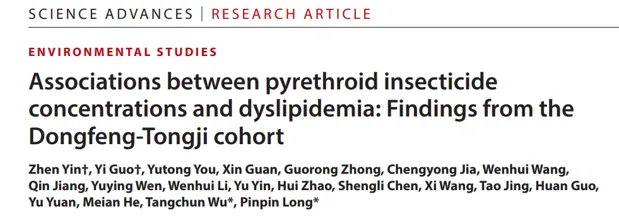
Pyrethroids are synthetic insecticides extensively employed in agriculture, residential environments, and food production. While generally considered to have low acute toxicity in mammals, their health impact under chronic low-level environmental exposure has yet to be fully established. Dyslipidemia represents a major risk factor for atherosclerotic cardiovascular disease. Previous population studies have relied on urinary metabolites, which lack specificity for individual pyrethroid compounds, and have been predominantly of cross-sectional design.
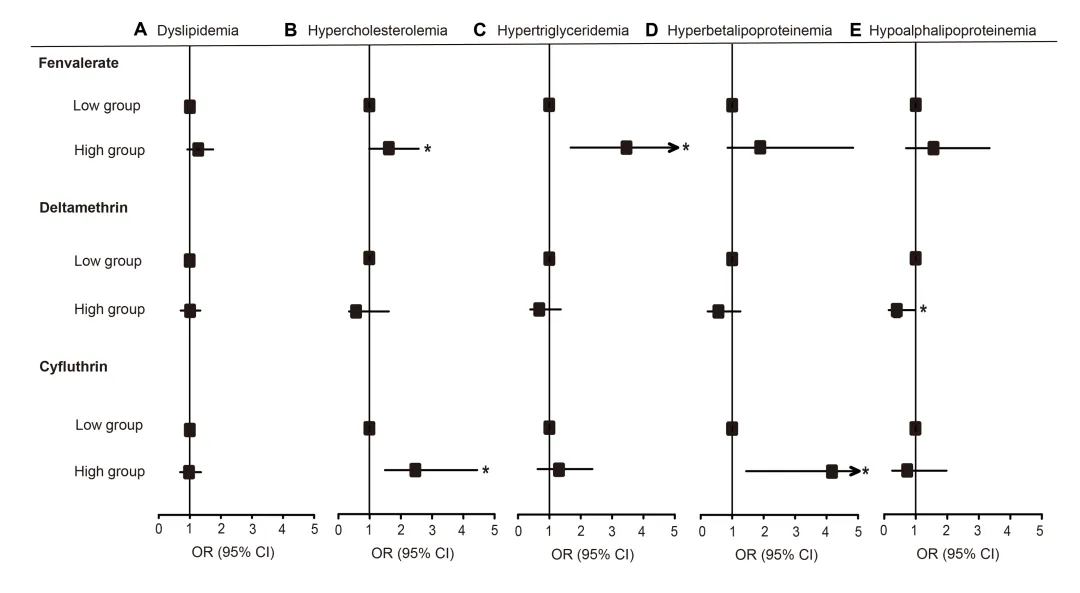
The HUST team directly measured seven parent pyrethroid compounds in human serum, including fenpropathrin, bifenthrin, cyfluthrin, cyhalothrin, permethrin, deltamethrin, and fenvalerate. Cross-sectional analyses revealed that fenvalerate and deltamethrin were associated with overall dyslipidemia and multiple subtypes, while cyfluthrin was primarily linked to hypertriglyceridemia. Dose-response relationships varied across different pyrethroids and lipid parameters.
Using quantile g-computation and weighted quantile sum regression to assess mixture effects, the team found that combined pyrethroid exposure was associated with overall dyslipidemia, hypercholesterolemia, hypertriglyceridemia, and elevated LDL-cholesterol. Fenvalerate consistently showed the strongest association signals across multiple outcomes.
Prospective follow-ups further demonstrated that individuals with higher baseline fenvalerate exposure had increased annual changes in total cholesterol (0.027 mmol/L) and LDL-cholesterol (0.022 mmol/L). Elevated fenvalerate exposure was also associated with incident hypertriglyceridemia (OR=3.44, 95% CI: 1.51–7.82). Cyfluthrin showed associations with certain new-onset dyslipidemia subtypes.
The study directly measured the parent compounds, which allowed for differentiation of health effects across specific pyrethroids, addressing a key limitation of previous metabolite-based approaches. By combining cross-sectional and prospective analyses, the research provides systematic population evidence on the cardiometabolic implications of pyrethroids, suggesting that environmental chemical exposures may represent modifiable factors beyond traditional genetic and lifestyle risk factors for lipid disorders.
Prof. WU Tangchun and Lecturer LONG Pinpin are the corresponding authors. Master's student YIN Zhen and doctoral student GUO Yi are co-first authors. The research received support from the National Natural Science Foundation of China and the Hubei Shizhen Laboratory Chief Scientist Program.





 Chinese