A research team from the School of Pharmacy, Tongji Medical College at Huazhong University of Science and Technology (HUST) has developed a novel artificial antigen-presenting cell platform that balances broad-spectrum tumor antigen coverage with efficient T-cell activation. The study, published in Proceedings of the National Academy of Sciences (PNAS), introduces a triple-signal engineered system capable of driving systemic antitumor immunity through an antigen relay mechanism.
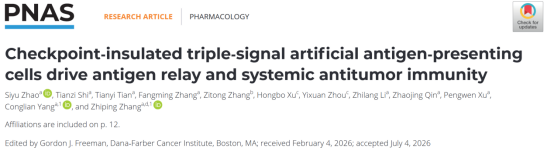
Effective tumor vaccines require both comprehensive antigen coverage and robust, sustained T-cell priming. Dendritic cell vaccines offer professional antigen presentation but are limited by narrow antigen coverage and low lymphoid homing efficiency, while whole-tumor cell vaccines preserve a complex antigen spectrum yet typically lack coordinated co-stimulatory and cytokine signals. Balancing these competing requirements within a single vaccine system has remained a major challenge.
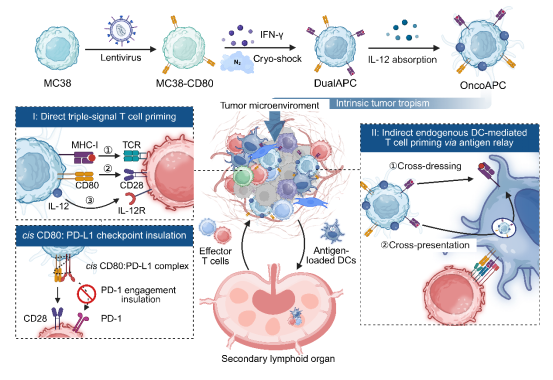
To address this issue, the team led by Professor ZHANG Zhiping and Associate Professor YANG Conglian engineered tumor cells into OncoAPC, a triple-signal artificial antigen-presenting cell. Through CD80 engineering, IFN-γ induction, and surface adsorption of IL-12, the researchers integrated three key signals—MHC-I antigen presentation, CD80 co-stimulation, and IL-12 cytokine stimulation—onto the tumor cell surface. Serum-free cryo-shock was simultaneously applied to eliminate proliferative and tumorigenic potential while preserving broad-spectrum tumor antigen information.
OncoAPC also exhibits an intrinsic checkpoint-insulating property: IFN-γ-induced PD-L1 forms a cis CD80:PD-L1 complex with engineered CD80 on the same membrane, reducing PD-L1 binding to T-cell PD-1 while preserving CD80-CD28 co-stimulation, thereby buffering PD-1-mediated immune suppression. Furthermore, OncoAPC mobilizes host dendritic cells through cross-presentation and cross-dressing, enabling an antigen relay from OncoAPC to host antigen-presenting cells that amplifies T-cell activation in lymphoid tissues.
In multiple MC38 tumor models, OncoAPC demonstrated significant therapeutic advantages. Some mice of subcutaneous tumor models achieved complete remission and remained protected after tumor rechallenge. OncoAPC also showed notable tumor control in peritoneal and hepatic metastasis models, outperforming conventional dendritic cell vaccines.
The team further validated the strategy's broad applicability. OncoAPC constructs for CT26 colorectal cancer, B16F10 melanoma, and 4T1 breast cancer all inhibited tumor growth. In an HT-29 human colon cancer model reconstituted with human PBMCs, human-derived OncoAPC similarly showed significant tumor suppression. Additionally, OncoAPC engineered from ex vivo resected tumor tissue demonstrated therapeutic efficacy comparable to its cell line-derived counterparts, supporting the platform's potential for individualized tumor antigen profiling.
The study was supported by funding from the National Natural Science Foundation of China. Doctoral student ZHAO Siyu is the first author, with Professor Zhang Zhiping and Associate Professor Yang Conglian serving as co-corresponding authors.





 Chinese