A research team led by Prof. YU Hongjun from the School of Basic Medical Sciences, Tongji Medical College at Huazhong University of Science and Technology (HUST) has published a landmark study in PNAS that resolves the long-standing mystery of how glycosylphosphatidylinositol-anchored proteins are recognized and selectively transported from the endoplasmic reticulum. The paper, titled “Architecture and mechanism of the human p24 cargo receptor” identifies the precise composition of the p24 cargo receptor complex and reveals its ordered assembly and pH-dependent cargo release mechanism.
Glycosylphosphatidylinositol modification is a unique glycolipid post-translational modification in eukaryotic cells that anchors proteins to the outer cell membrane. This modification plays critical roles in complement regulation, immune responses, neural development, and signal transduction. Abnormalities in the GPI pathway are linked to paroxysmal nocturnal hemoglobinuria, congenital GPI deficiency syndrome, intellectual disability, and epilepsy. GPI modification is also essential for the growth and pathogenicity of pathogenic fungi, making it an emerging target for antifungal drugs. Yet, how GPI-anchored proteins are recognized and exported from the endoplasmic reticulum has remained a central unresolved question.
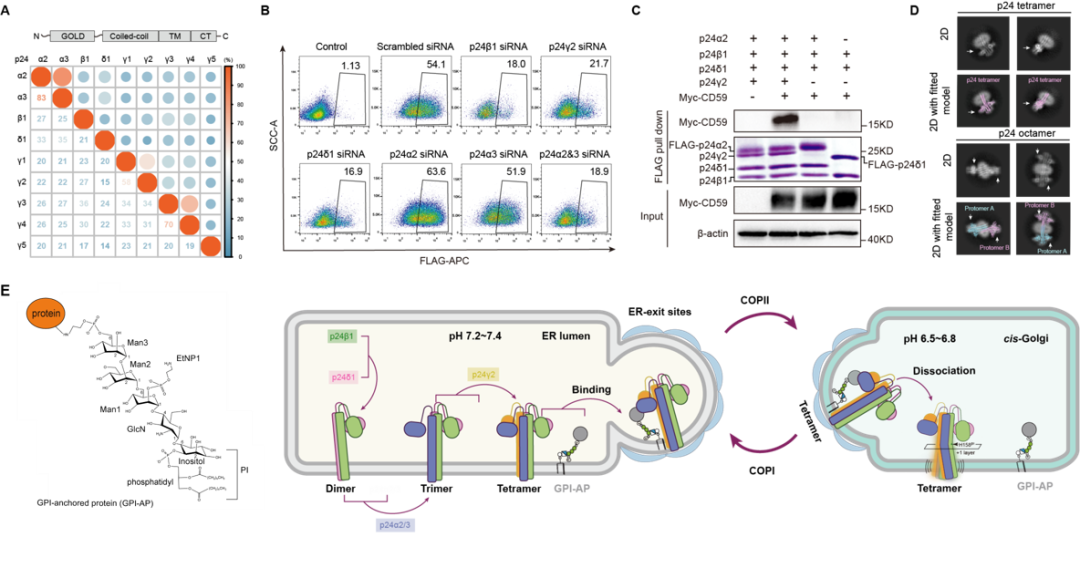
The p24 family is a key cargo receptor in the early secretory pathway, involved in transporting GPI-APs, Wnt ligands, Toll-like receptors, and fibronectin. With ten members across four subfamilies (α, β, δ, and γ), their functional combinations have long been controversial. Using a GPI-AP cellular transport reporter system, RNA interference, functional complex reconstitution, and CD59-GPI-cargo binding assays, the team determined that a heterotetramer composed of p24α2 or p24α3, p24β1, p24δ1, and p24γ2 constitutes the fundamental functional unit mediating GPI-AP recognition. Notably, p24α2 and p24α3 show functional redundancy, while among the five γ subunits, only p24γ2 can effectively integrate into the complex.
The study further revealed an ordered assembly mechanism. p24β1 and p24δ1 first form a stable core, then recruit either p24α2 or p24α3. However, these intermediate complexes cannot bind GPI-AP effectively; only after p24γ2 is added does a fully functional receptor with cargo-binding capacity form—a stepwise maturation process.
Addressing another classic question—how cargo is released at the correct location—the team captured conformational states at different pH levels (7.5, 6.8, and 5.0). Acidification does not cause receptor dissociation but instead induces synergistic conformational changes in the membrane-proximal coiled-coil region and transmembrane helices. Conserved proton-sensitive residues in the coiled-coil domain form a pH-sensing network, with key sites such as H158 in p24β1 potentially altering local interactions through protonation and transmitting this signal to the transmembrane region to regulate cargo binding.
Using GPI-AP as a model cargo, this study establishes the p24 heterotetramer as the functional cargo receptor mediating GPI-AP recognition and transport, and elucidates its ordered assembly and pH-dependent cargo release mechanism, providing fundamental insights into how the p24 family forms a complex cargo transport system with a limited number of subunits.
Prof. YU is the sole corresponding author. Doctoral students HUA Zhengkang and ZHANG Di are co-first authors. Associate Researcher ZHANG Min made key contributions to system establishment, data analysis, and manuscript preparation. Prof. Taroh Kinoshita of Osaka University and Prof. LIU Yishi of Jiangnan University provided significant support for this research.




 Chinese