A research team from the Institute of Reproductive Health, Tongji Medical College at Huazhong University of Science and Technology (HUST) has uncovered a new mechanism linking advanced maternal age to adverse pregnancy outcomes, shifting the focus from traditional explanations centered on ovarian aging and embryo quality to the immune microenvironment of the uterus. The findings were published in Aging Cell.
As maternal age grows, the risk of pregnancy loss and placental abnormalities rises significantly. While declining ovarian function and oocyte quality have long been considered primary contributors, the uterine decidua—the tissue where embryo implantation occurs—has received less attention. The study, led by Prof. LIAO Aihua, demonstrates that decidual macrophages undergo age-related senescence, disrupting the delicate immune balance essential for successful pregnancy.
Upon analysis of human decidual samples from early pregnancy, the team found that, in women aged 35 and older, pro-inflammatory M1 macrophages increased while anti-inflammatory M2 macrophages decreased, leading to an elevated M1/M2 ratio. These aged macrophages also exhibited classical senescence markers: elevated p53 and SA-β-Gal, increased reactive oxygen species, reduced phagocytic capacity, and heightened senescence-associated secretory phenotype. Importantly, these senescent macrophages impaired trophoblast function and contributed to abnormal placental development.
By using mouse models, the researchers examined the effects of maternal and paternal age through embryo transfer experiments. When embryos from young mothers were transferred to aged recipients, the resorption rate went up significantly—whereas embryos from aged mothers transferred to young recipients did not show a similar rise. This provides direct evidence that the uterine microenvironment, not just embryo quality, plays a decisive role in determining the pregnancy outcomes in older mothers.
The study further identified both internal and external drivers of decidual macrophage senescence. RNA sequencing revealed that FOXO3, a key regulator of cellular aging, was downregulated in aged decidual macrophages. Simultaneously, elevated IL-6 levels in the aged uterine microenvironment activated the STAT3 signaling pathway, promoting macrophage senescence through external inflammatory signals.
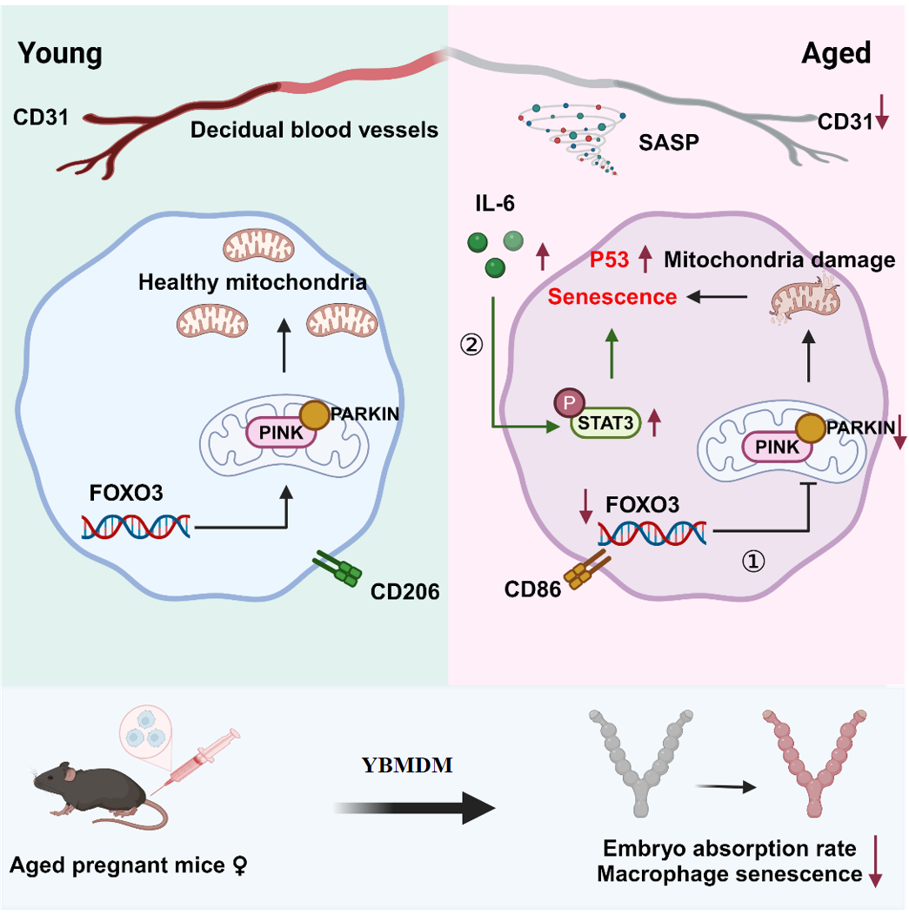
Encouragingly, the team demonstrated that this process may be reversible. Adoptive transfer of bone marrow-derived macrophages from young mice into aged recipients significantly lowered embryo resorption, improved placental development, and increased fetal counts in late pregnancy. Blocking the IL-6 receptor yielded comparable benefits.
These findings suggest that immune aging at the maternal-fetal interface is not an inevitable consequence of advanced age but a potentially modifiable factor. The study opens new avenues for risk assessment and intervention strategies targeting the FOXO3-mitochondrial autophagy pathway, the IL-6/STAT3 inflammatory axis, and macrophage functional remodeling.
The research expands the understanding of adverse pregnancy outcomes in advanced maternal age from a narrow focus on embryo quality to a broader perspective that includes uterine immune aging. It positions senescent decidual macrophages as a central mediator linking inflammation, trophoblast dysfunction, and placental abnormalities, and offers a promising therapeutic direction for improving pregnancy outcomes in older women.
Dr. ZHANG Yujing from the Institute of Reproductive Health is the first author, with Prof. LIAO Aihua serving as the sole corresponding author. The Institute of Reproductive Health, Tongji Medical College of HUST is listed as the lead institution.




 Chinese