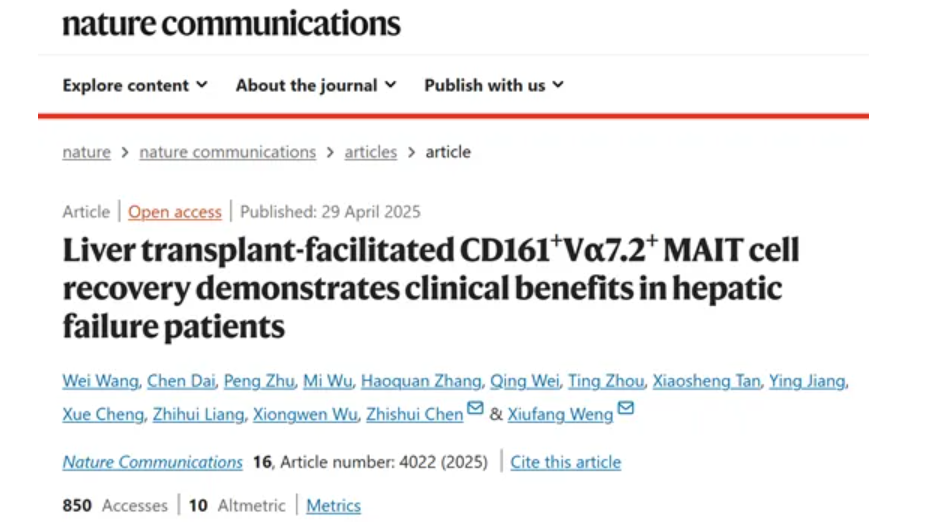
Wuhan, China – A research team led by Prof. WENG Xiufang from School of Basic Medicine, Tongji Medical College of HUST has made significant progress in understanding immune mechanisms underlying HBV-related liver failure. Their findings were published in Nature Communications on April 29, 2025, under the title "Liver transplant-facilitated CD161+Vα7.2+ MAIT cell recovery demonstrates clinical benefits in hepatic failure patients."
The study revealed that patients with HBV-induced liver failure suffered from significant exhaustion and dysfunction of mucosal-associated invariant T (MAIT) cells, with the severity being correlated to disease progression and bile acid accumulation. Importantly, the research demonstrated that liver transplantation helped restore both the quantity and function of these critical immune cells.
Their key discoveries include:
s MAIT cell frequency dramatically dropped in hepatic failure patients;
s Bile acids and inflammatory cytokines negatively impacted MAIT cell function;
s Post-transplant MAIT cell recovery originated from recipients, not donors;
s Restored MAIT cells exhibited enhanced protective capabilities;
s MAIT cell levels correlated with clinical outcomes, serving as potential prognostic biomarkers
Prof. WENG's team found that patients enjoying better MAIT cell recovery within one month after transplantation experienced fewer complications, suggesting the utility of these cells in clinical prognostication.
The research represents a result of collaboration between basic and clinical medicine, with the publication co-authored by Dr. WANG Wei from the School of Basic Medicine and Dr. DAI Chen from Institute of Organ Transplantation of Tongji Hospital, serving as lead authors. Prof. WENG Xiufang and Prof. CHEN Zhishui are the corresponding authors.
This work provides novel insights into immune mechanisms of liver failure and potential clinical applications for improving transplant outcomes, particularly in HBV-endemic regions.




 Chinese