A research team led by Prof. SUN Shuguo and Prof. LI Yan from School of Basic Medicine, Tongji Medical Colege of HUST has made a breakthrough in understanding the activation mechanism of the YAP/TAZ oncoproteins. Their findings, published in Nature Communications on April 24, 2025, revealed new possibilities for targeted cancer treatment.
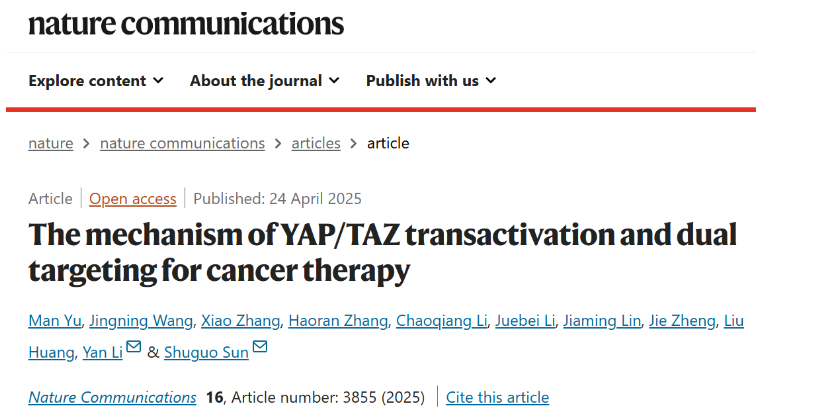
The study successfully identified the core transactivation domain (TAD) of the YAP protein, located between amino acids 450-504, and deciphered its structural features and functional mechanisms culpable for tumor development and resistance to immunotherapy. This discovery enabled the team to develop novel inhibitors specifically targeting this critical protein region.
For years, the scientific community has struggled to understand how transcriptional activation domains function, as these intrinsically disordered regions lack conserved sequences or obvious structural features. The HUST team's work shed light on this molecular mystery by demonstrating how YAP's TAD works through a dual mechanism involving both transcriptional initiation and elongation processes.
Through detailed structural analysis using nuclear magnetic resonance (NMR), researchers discovered that YAP's activation domain consists of an amphipathic helix combined with a terminal hydrophobic motif. This unique configuration allows the protein to drive cancer progression by recruiting essential transcription machinery through two separate pathways: one involving the TFIID complex via TAF4, and the other engaging the mediator complex through MED15.
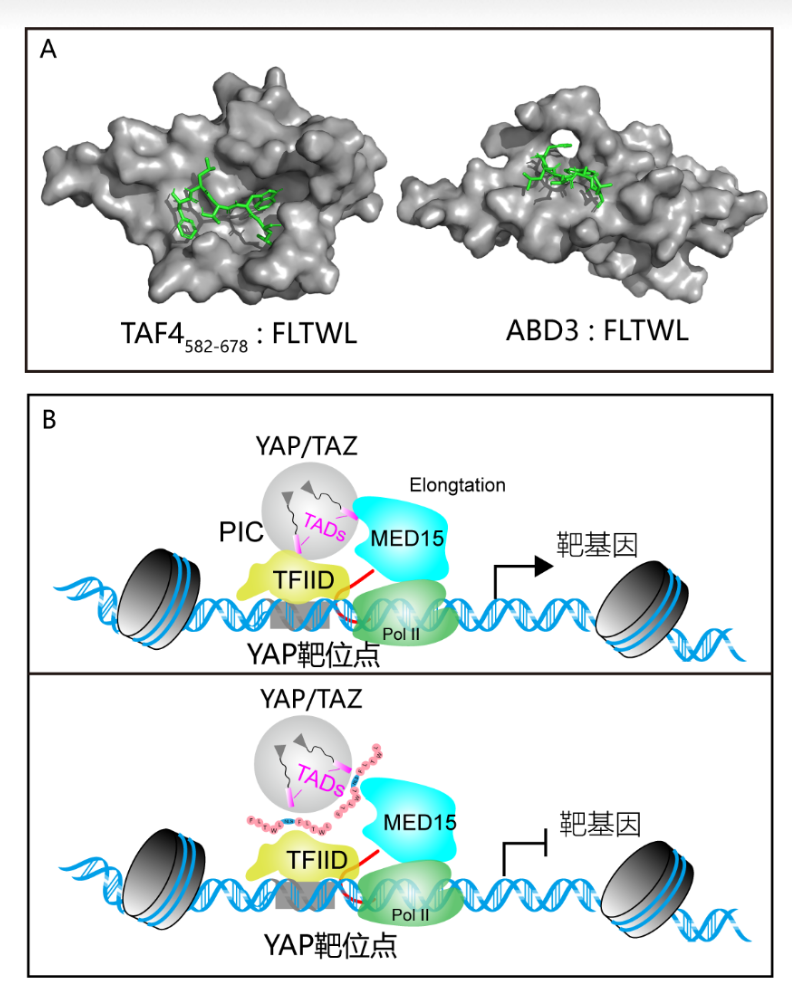
The implications of this discovery go beyond the basic sciences. The research team developed a synthetic peptide, TJ-M11, that effectively disrupts the interaction between YAP's activation domain and its partner proteins. Experimental results showed that this intervention significantly inhibited tumor growth while simultaneously enhancing the efficacy of immunotherapy.
In this study, basic science researchers teamed up with and clinicians in the HUST, with additional support from the Shanghai Institute of Materia Medica. Dr. YU Man and Dr. WANG Jingning are co-lead authors of the publication.




 Chinese