A research team led by Prof. WU Tongbo from the School of Pharmacy at Tongji Medical College, Huazhong University of Science and Technology (HUST), in collaboration with researchers from affiliated Union Hospital, has developed a novel activator that allows the CRISPR-Cas12a system to function without the previously required protospacer-adjacent motif (PAM). The study was published online on June 25 in Nucleic Acids Research.
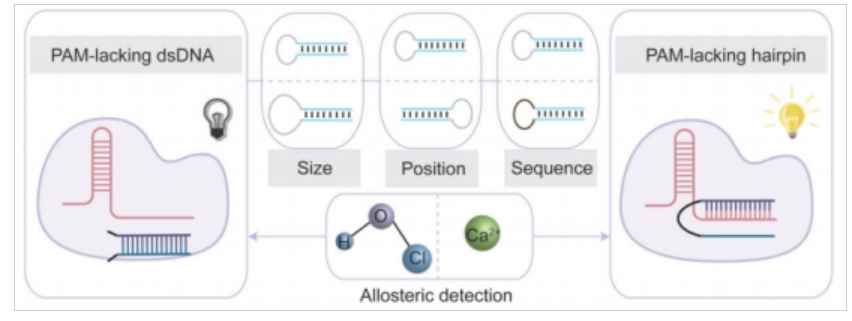
Conventional Cas12a systems depend on double-stranded DNA activators that contain a specific PAM sequence (5′-TTTV-3′), which significantly limits their applicability. The newly designed hairpin-structured activator eliminates this constraint by using a loop region with any sequence and a double-stranded stem that serves as the protospacer. This structure robustly triggers Cas12a’s trans-cleavage activity without a PAM sequence.
The team demonstrated that Cas12a activity can be precisely modulated by adjusting the hairpin’s position or size. On the basis of this mechanism, they developed an allosteric probe strategy capable of converting hairpin DNA into double-stranded DNA, allowing for highly sensitive detection of non-nucleic acid targets—including hypochlorous acid and calcium ions—without background interference or complex probe design.
The breakthrough offers a versatile and efficient platform for next-generation molecular diagnostics and biosensing applications.
PhD candidate Li Xiaolong (Class of 2022) from the School of Pharmacy is the first author of the study. Collaborators included Dr. Hong Jiaxin and Dr. Huang Yongming from Union Hospital.
Article link:https://academic.oup.com/nar/article/53/12/gkaf596/8173576





 Chinese